

The year 1968 did not arrive quietly. It came fractured, marked by assassinations, the Vietnam War broadcast into American living rooms, and a widening sense that the nation was no longer merely observing itself, but being forced to watch its own unraveling in real time.
Television had become the country’s primary shared space, yet it remained uncertain what kind of space it was meant to be: a civic instrument, a commercial engine, or something more ambiguous still. In the preceding decade, three creators had already begun to answer that question, in surprisingly related ways.

“Submitted for your approval…”
In his own words, Serling explained “precensorship” to Mike Wallace in this 1959 interview.
Rod Serling, working within the constraints of network television, developed in The Twilight Zone a form of allegorical storytelling that allowed contemporary anxieties about conformity, prejudice, and state power, to be expressed only through displacement from reality. In his universe, a man stood alone at the end of the world; a town where judgment arrived without explanation; a society undone by its own unexamined assumptions. Serling demonstrated that television, even under commercial constraint, could function as a moral instrument, so long as meaning was routed through metaphor.

“To boldly go where no man has gone before.”
If Serling’s work operated through distortion, Gene Roddenberry’s Star Trek proposed a different strategy: projection. Rather than refracting the present through allegory, Roddenberry placed it into the future. The starship Enterprise did not represent an escape from history so much as an extension of it, carrying forward unresolved questions of war, governance, and identity into a speculative framework where they could be examined without immediate political consequence.
In this sense, Star Trek functioned less as entertainment than as a premise that human beings might eventually organize themselves around exploration rather than conflict. It was less a prediction than an ethical argument.

“You’ve made this day a special day, by just your being you.”
In his own words, during an interview for NET Presents The Creative Person, Rogers expresses a deep concern about the United States putting pressure on young children to grow up, so that, “He will be a great consumer one day” instead of being appreciated for who he is in the moment.
Where Serling and Roddenberry relied on distance, Fred Rogers was fully present and deeply reflective. When Mister Rogers’ Neighborhood went national in 1968, it entered a media environment increasingly shaped by speed, stimulation, and commercial saturation. Rogers’ response was not to compete within those terms but to reject them. The program’s pacing, tone, and structure were defined by refusal. A refusal of urgency, irony, and the assumption that attention must be constantly captured rather than patiently earned. In the Neighborhood of Make-Believe, figures such as Daniel Striped Tiger and King Friday XIII served not as escapist characters but as instruments of emotional articulation. The program’s central innovation was its insistence that complex feelings like fear, anger, and uncertainty were not peripheral to childhood experience but foundational to it. Together, we could mention and manage all of our emotions. We could process the complexities of reality through the language of make-believe.
Taken together, these three seemingly different approaches suggested, if not a shared aesthetic, a shared premise: if television was not being used to its full potential, why not change it?
By the late 1970s, that premise was becoming increasingly difficult to sustain. The economic structure of broadcasting, built on sponsorship, ratings pressure, and audience aggregation placed growing emphasis on efficiency of attention rather than depth of engagement. Even the most formally ambitious programs were required to justify themselves in commercial terms. Serling, Roddenberry, and Rogers each created within that contradiction rather than outside it.
The result was not resolution but tension: art capable of moral seriousness, operating within a delivery structure indifferent to it.

“I’m excited for tomorrow. You know why? Because I know that you are going to be there.”
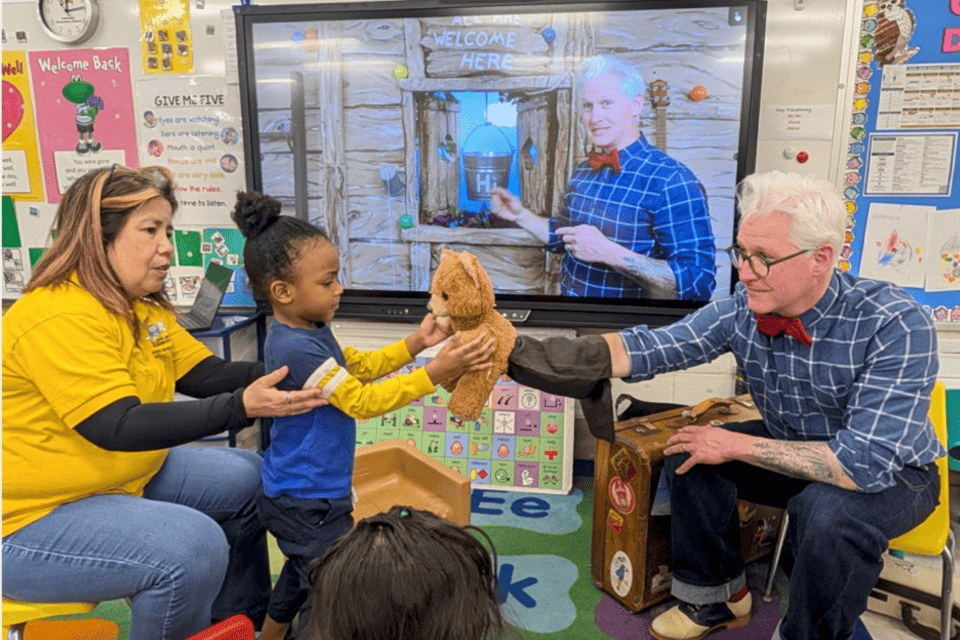
I did not grow up inside the system that those whom I consider to be my predecessors navigated, so much as I inherited the consequences of that system. By the time I began working on Danny Joe’s Tree House, the problem had shifted several times over. The question was no longer only what television was doing, but what media itself had become. The broadcast model that shaped Serling’s work had given way to something less centralized and more pervasive: algorithmic distribution, behavioral tracking, and systems of recommendation that operate continuously, without clear authorship or endpoint. The audience is no longer simply addressed, it is modeled, segmented, and predicted.
In such an environment, the older distinction between content and commerce becomes increasingly unstable. What Rogers understood as commercial influence, and what Serling and Roddenberry navigated through narrative form, has evolved into something more encompassing. Attention itself has become the primary economic unit. Beyond just competing for attention, today’s media conditions both the audience and the creator for absolute retention above all else.
To create within this environment is to confront a different scale of problem. It is no longer sufficient to ask what a show says. One must also ask what it interrupts, what it accelerates, and what it influences its audience and fellow creators to expect as a norm.
The challenge is not only creative but structural. It requires, at minimum, a refusal to accept that acceleration is inevitable, and a return to an older, more fragile humanistic belief: that attention is not merely something to be captured and controlled, but something to be respected and earned.
In the field of early childhood development there is a name for this type of process: regression. When a young child is facing a new and often overwhelming challenge, a new school, moving into a new home, the birth of a new sibling, that child often regresses to younger behaviors. Parents and caregivers are often dumbfounded, as they thought a particular age and developmental stage challenge was already processed and mastered. But the simple truth is that sometimes we need to go back to what is safe and familiar and reestablish our sense of security before accelerating forward. I think that is what is happening across our country right now at the start of summer 2026. Many of us have been, in a sense, wetting the bed and hanging on to our security blankets for dear life!
We desperately need trusted moral guides again to help us to move forward.
Like my hero, Fred Rogers, I begin with the premise that children are not future consumers but present minds, capable of developing critical thinking skills for themselves and deep empathy for others. I observe through my time with families in early childhood classrooms, libraries, children’s museums, other child-friendly institutions, and through media and technology, that today’s children, and their grownups, are more than capable of engaging in the process of forming emotional and cognitive frameworks. They just need environments on and off the ever-evolving screen to practice, refine, and apply these skills. We have a social responsibility as today’s storytellers to empower the next generation to navigate future challenges.
Like Serling, I remain attentive to the ways in which systems disguise themselves as neutrality. And like Roddenberry, I retain some belief, however strained by circumstance, that constructed environments can still be oriented toward a common societal benefit.
What has changed is the scale of mediation between creator and audience. The “show” is no longer a bounded object with a defined beginning and end. It is an entry point into a continuous system of engagement, one that rarely pauses long enough to be recognized as such.
Serling, Roddenberry, and Rogers each understood, in their own ways, that stories should reflect and in turn reshape perception. To tell a story in that lineage is to trust that the audience is not a target market to manipulate, but an equal participant in meaning-making. That what is received is not finished, but carried forward, altered, and eventually spoken again in another form.
The art of storytelling was never just about making a show. It was always, in some quiet and persistent way, an invitation to continue our shared story.